the Triassic - 248 to 206 Million Years Ago
|
|
|
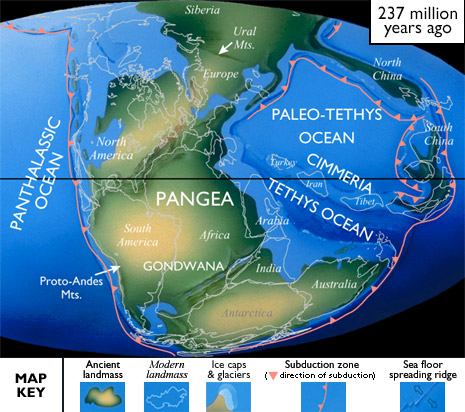
World Paleogeography: Western Pangea had already assembled, and Eastern Pangea began to assemble from terranes in the Paleo-Tethys Ocean. Cimmeria and the Cathaysian terranes collided with Siberia in the Middle Triassic. This collision closed the Paleo-Tethys Ocean and opened the Tethys Ocean. By the latest Triassic, just as the formation of Pangea was complete, the supercontinent began to break up, and rifts developed between North America, Africa, and South America. The large emergent landmass and rain shadows from several high mountain belts created an arid climate and resulted in large seasonal temperature variations over most of the supercontinent throughout the Triassic. North American Paleogeography: As Pangea began to break apart, rift basins developed along the modern East Coast and filled with sediment and lava flows. During the rifting, regions that once were part of Africa remained attached to North America, including parts of the Atlantic Coastal Plain and most of Florida. Highlands in eastern North America shed copious amounts of sediment into the lower areas that dominated the central part of the continent. Shallow seas covered most of the continent west of the modern Rocky Mountains and north into Canada, but subduction along the continental margin generated small volcanic landmasses that began to form the core of the ancestral Sierra Nevada. A subduction zone was located off the west coast of future Mexico. Paleontology: The Triassic Period was a time of transition as life on Earth was recovering from the great mass extinction that ended the Paleozoic Era. The dinosaurs made their first appearance in the Triassic, and diversified to dominate the terrestrial faunas for the next 180 million years. The Triassic seas were home to other large reptiles, such as ichthyosaurs and plesiosaurs, as well as invertebrate survivors of the Permian extinction, such as a few ammonites, brachiopods, and molluscs. The earliest flying vertebrates, the pterosaurs, evolved during the late Triassic. One other vertebrate group evolved in the Triassic at about the same time as the dinosaurs: the mammals. The first mammals were tiny, about the size of the modern shrew or mouse. Mammals diversified slightly during the Mesozoic, but would not become major players until the Cenozoic.
|
|
 |
See the Triassic in:
Or jump to another period:
|
|
Links to more about the Triassic
|
Research and Collections | Organizations | Education and Exhibits | Research and Collections | Resources
Research and Collections
(showing 1 of 1 listings)
The Natural History Museum, London's conodont collection: This database gives broad information about discrete collections within the conodont collection housed at the NHM. Generic, specific and subspecific names are included in the database, but the data is being updated regularly. As a result, the database is best searched by name of donor/collector/publisher or by geological period. Links to images are included with some collections.
 Top of List Top of List
Organizations
Parks (showing 1 of 1 listings)
Berlin-Ichthyosaur State Park: This park was first established in 1957 to protect and display North America's most abundant concentration of, and largest known, ichthyosaur fossils.
Top of List
Museums (showing 3 of 6 listings)
Fort Worth Museum of Science and History: The Fort Worth Museum of Science and History is a leader in informal science education and provides hundreds of programs aimed at engaging children and families in learning. DinoDig® combines life-sized representations of dinosaurs with a large outdoor discovery area where visitors can become amateur paleontologists and dig for dinosaur bones. There is also a permanent exhibit of Texas dinosaurs featuring several mounted specimens.
Alabama Museum of Natural History: Collections: Experience the natural diversity of Alabama through exhibits from the Age of Dinosaurs, the Coal Age, and the Ice Age. View the Alabama Museum of Natural History's extensive collections of geology, zoology, mineralogy, paleontology, ethnology, history, and photography. Located in historic Smith Hall on the University of Alabama campus, the Museum's mission is to broaden the knowledge of natural sciences and human culture through collections and quality programs of research, instruction, and service; many family-friendly events are offered.
Museum of Western Colorado's Dinosaur Journey: Provides information on visiting the museum, as well as the paleontology of western Colorado and surrounding areas.
 More Museums More Museums
Top of List
Education and Exhibits
Events and Programs (showing 2 of 2 listings)
Rockin' Through the Ages: From Fossils to Petroglyphs: Petrified Forest National Park's curriculum-based education program allows students to explore both paleonotology and archeology using in-class lessons and a field trip to the park. 
Late Triassic Ichthyosaur And Invertebrate Fossils In Nevada: Virtual field trips to two classic fossil localities in the Upper Triassic Luning Formation of Nevada; detailed text; on-site images; photos of fossils.
Top of List
Virtual Exhibits (showing 3 of 6 listings)
Dinobuzz: Current Topics Concerning Dinosaurs: Unfortunately, the science of dinosaur paleontology is often obscured by the fantasy that surrounds it. This site from the UC Museum of Paleontology addresses fact vs. fiction on some popular dinosaur-related topics.
Ancient Denvers: Ancient Denvers is a virtual exhibit that highlights 13 reconstructions of ancient Colorado landscapes.
Virtual Museum of Fossils: Geosciences, at Georgia's Valdosta State University, presents an interactive virtual museum of invertebrate and vertebrate fossil specimens. Explore the collection by animal, or by time period from Precambrian to Quaternary. Maps are detailed and include ecosystem distribution. Fossil photographs, many showing multiple views, list information about where the fossil was found, and how it is categorized taxonomically. Some pages feature a drawing of the animal's skeleton showing the fossil bone in red.
More Virtual Exhibits
Top of List
Physical Exhibits (showing 1 of 1 listings)
Maryland Science Center Exhibits: This site details information on exhibits at the Maryland Science Center, including Dinosaur Mysteries (featuring a cast T. rex skeleton, models of Maryland's dinosaurs, and other exhibits), Fossil Quest, and TerraLink (highlighting geology and other earth sciences).
Top of List
Research and Collections
Researchers (showing 3 of 3 listings)
Francois Therrien PaleoProfile: Therrien worked in the Triassic formations of Petrified Forest National Park in Arizona, specializing in dinosaurs.
University of Kansas Paleobotanical Collection: Collection of fossil plants currently housed at the University of Kansas.
Paleobotany and Palynology at the Florida Museum of Natural History: The Paleobotany and Palynology Collection at the Florida Museum of Natural History is international in scope, including collections from 47 countries. Systematically the greatest strength of the collection is in Cretaceous-Tertiary angiosperms.
Top of List
Ongoing Research Projects (showing 2 of 2 listings)
Sam Noble Oklahoma Museum of Natural History: On the campus of the University of Oklahoma in Norman. One of the finest university-based museums in the nation, with an active Paleontology research program and extensive collections.
Transantarctic Vertebrate Paleontology Project: The Transantarctic Vertebrate Paleontology Project involves the collection and study of Triassic to Jurassic age vertebrates from the southern Transantarctic Mountains near the Beardmore and Shackleton Glaciers, Antarctica. William R. Hammer of Augustana College, currently the Principal Investigator on a National Science Foundation grant supporting this research, has led seven vertebrate collecting expeditions to these regions since 1977. To date faunas of four different ages have been studied. Included among the taxa discovered are synapsids, prolacertids, procolophonids, a rauisuchid and a variety of temnospondyl amphibians from the Early Triassic, synapsids and large capitosaurid temnospondyls from the early Middle Triassic, a few indeterminant bone fragments and a dicynodont tusk from the Late Traissic, and a theropod, prosauropod, ?sauropod, tritylodont, and pterosaur from the Early Jurassic.
Top of List
Resources
Annotated Bibliographies (showing 1 of 1 listings)
Bibliography of Paleobotany: A bibliographic database of paleobotany including more than 56,000 entries. It also includes references on Antarctic geology and paleontology and citations on Women in Science.
Top of List
Maps (showing 1 of 1 listings)
Paleogeography and Geologic Evolution of North America: The images presented here show the paleogeography of North America over the last 550 million years of geologic history.
Top of List
Courses and Lectures (showing 1 of 1 listings)
Paleogeography of the Southwestern U.S.: The paleogeography of the southwestern U.S. from 1.8 billion years ago to 10 million years ago. Text and images by Dr. Ron Blakey from Northern Arizona University.
Top of List
Field Guides (showing 3 of 4 listings)
Fossil Cephalopods in Utah: A reference to help provide information on the identity, biostratigraphy and location of fossil cephalopods found in the state of Utah.
Ammonoids At Union Wash, California: Visit a famous Early Triassic ammonite locality in the shadows of Mount Whitney; virtual field trip; many images of fossils; paleontology links, plus links to Inyo County.
Early Triassic Ammonoid Fossils In Nevada: A virtual field trip to what could well be the single best early Triassic ammonoid locality in North America; detailed text; images of fossils; on-site images.
More Field Guides
Top of List
Databases (showing 3 of 3 listings)
New Mexico Museum of Natural History and Science Web-based Paleo-database Home Page: Search the fossil collections of the New Mexico Museum of Natural History and Science. Listings by Kingdom down to species, era, epoch, group, formation, country, New Mexico county, and map ID. Many listings contain images of the fossils (including all holotypes.)
The Paleointegration Project: The PaleoIntegration Project (PIP) is facilitating interoperability between global-scale fossil and sedimentary rock databases (e.g. The Paleobiology Database and the Paleogeographic Atlas Project), enabling a greater understanding of the life, geography and climate of our planet throughout the Phanerozoic. Databases can be searched via text and interactive maps, and by any combination of age, location, or content. Results can be plotted on present- and paleo- maps or downloaded for detailed analyses.
Stratigraphy.net: Stratigraphy.Net aims to provide free and open access to geoscientific information and data with special emphasis on the disciplines stratigraphy, paleontology and sedimentology.
Top of List
Image Collections (showing 2 of 2 listings)
Some Fossil Brachiopods: Images of several fossil brachiopods, dating in geologic age from early Cambrian to Pleistocene, with explanatory text.
Fossil Images from Grand Staircase-Escalante National Monument: A pictorial essay of fossil life in the Grand Staircase National Monument, unveiled by Utah Geological Survey (UGS) staff.
Top of List
General Reference (showing 3 of 6 listings)
SkeletalDrawing.com: An anatomical resource for artist and amateurs who want to learn about the science behind restoring prehistoric animals, with an emphasis on dinosaurs. Includes many skeletal reconstructions.
Fossil Triassic plants of Sonora, Mexico: A discussion of fossil plants from the Santa Clara Formation accompanied by photographs.
Fossils In Death Valley National Park: The paleontology, geology and natural wonders of Death Valley National Park (and more); many images of fossils; field trips; paleontology links, plus links to Death Valley.
More General Reference
Top of List
|
|